

How Centralized Labour Quarters Help JTK Improve Compliance and Worker Housing Standards in Malaysia

In Malaysia, employers can no longer deal with worker housing as a side issue. It has become a regulated duty that has to do with safety, health, legal compliance, and labour standards. This stance is why Centralised Labour Quarters, or CLQ, are becoming more and more important. CLQ does more than just help businesses find better places to live for their employees. It also helps Jabatan Tenaga Kerja Semenanjung Malaysia (JTKSM) do its job better under the Employee's Minimum Standards of Housing, Accommodations and Amenities Act 1990 (Act 446). JTKSM makes it clear that it enforces the rules and requirements that employers must follow when they provide housing, accommodations, and facilities for their workers. The purpose of this enforcement is to ensure the living space remains safe, clean, and comfortable.
This aspect is where CLQ really comes into play. Compared to having worker housing spread out over flats, shoplots, terraces, and ad-hoc rental units, a well-planned CLQ gives JTK a more organised, standardised, and manageable place to live. The corporate function page for JTKSM also says that one of its jobs is to handle and look into applications for a certificate of accommodation under Act 446. In other words, JTK in Centrtalised Labour Quarter is not just enforcing general labour standards; it is also directly involved in the housing system. When worker housing is organised and made official, the work becomes more organised.
Understanding JTK’s role in worker accommodation
It's important to know what JTK is really in charge of in order to understand how CLQ helps it. The housing and accommodation service page for JTKSM says that Act 446 applies to housing issues for workers in Peninsular Malaysia and the Federal Territory of Labuan. The same page also says that Part IIIA of the Act applies to housing for workers who do not work on estates. So, JTKSM is not just watching the housing problem from the outside. It is one of the main groups in charge of enforcing, running, and keeping an eye on things in this area.
The FAQ for JTKSM also says that it enforces housing and accommodation through Act 446 and its rules. The Act itself says that employers must notify occupations, that accommodation must meet minimum standards, and that accommodation must follow local laws. Part IIIA of the Act also says that foreign workers must be given housing. When you look at all of this, it's clear that worker housing is not a minor issue. JTK has direct responsibilities in this area of regulation.
CLQ helps JTK by making enforcement more structured
One of the best things about JTK's and CLQ's is that they turn worker accommodation from a random problem into a well-organised system for following the rules. The 2020 accommodation rules and Act 446 set rules that employers and centralised accommodation providers must follow. JTKSM also has an official public List of Worker Accommodation Centres. This list has the names of the providers, their certificate numbers, the dates their certificates are valid, and the addresses of the centres. The page says it was last updated "as at February 2026. "This means that the government is not just telling businesses to do better. It is creating a structured environment for accommodations with registration, certification, and visibility.
That structure is important to JTK. It is easier to find, document, certify, and keep an eye on workers when they are all in one place, like a CLQ, than when they are spread out across many different places. Although JTKSM does not say this in those exact words, it is a reasonable conclusion based on the law: it is easier to govern a centralised and certified site than a bunch of informal, scattered housing arrangements. In practice, CLQ helps JTK move from a reactive firefighting model for overseeing housing to a more orderly regulatory model.
CLQ supports JTK’s certification and investigation process
The function page for JTKSM says that the department looks into and processes applications for certificates of accommodation under Act 446. That point is crucial. It indicates that JTK is involved in the application and verification stages, not just checking accommodations after problems come up. Act 446 says that an employee can't get accommodations unless they have a Certificate of Accommodation. CLQ helps JTK do its job by making worker accommodation certifiable.
This is one of the best reasons why CLQ helps JTK. A satisfactory CLQ should be a place where people can stay that has a clear operator, a responsible party, a known location, and a set of standards that can be measured. That fits in much better with a regulatory system based on certificates than with housing that is scattered, inconsistent, or only somewhat formal. In other words, CLQ helps JTK because it provides the department something clear to look at, check out, and approve under Act 446.
CLQ helps JTK enforce minimum standards more effectively
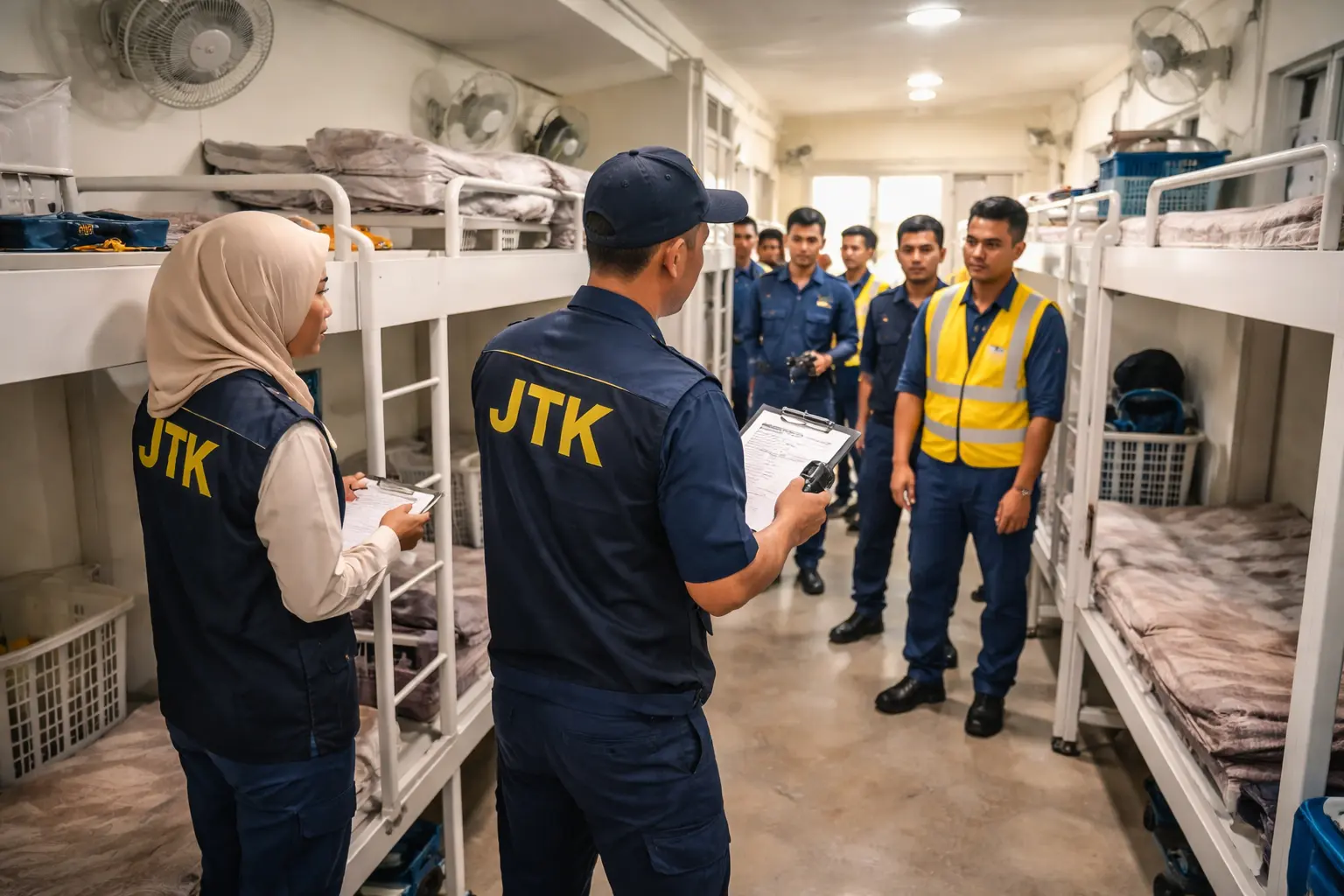
The Employees' Minimum Standards of Housing, Accommodations, and Amenities (Accommodation and Centralised Accommodation) Regulations 2020 spell out what is required for accommodation and centralised accommodation. According to JTKSM's FAQ, employers and centralised accommodation providers must follow these rules when it comes to providing facilities. The rules cover things like basic amenities in housing, and JTKSM's service page says that enforcement is about making sure that people have a safe, clean, and comfortable place to live.
This is another way that CLQ helps JTK. When accommodation is centralised, it is easier to make sure that minimum standards are always met. JTK can check to see if a single accommodation site is meeting the required standards instead of having to deal with many different premises of different quality. That doesn't mean that all CLQs are automatically compliant, but it does mean that the regulatory object is easier to handle. Standardisation is a strong tool for an enforcement agency. It makes things clearer, holds people accountable, and makes it easier to find problems. That is a reasonable conclusion based on how Act 446 and the rules from 2020 are set up.
CLQ helps JTK protect the health and safety of its workers, not just legal compliance
It's important to look at how JTKSM wrote it. It doesn't just talk about its accommodation enforcement in legal terms. The department says that another goal is to make the living space safe, clean, and comfortable. That means that JTK's job isn't just to punish people. It is also focused on welfare in the rules that govern labour. CLQ backs that goal because centralised housing makes it easier to set a minimum standard of living for a larger group of workers.
Act 446 also talks about safety and health responsibilities, maintenance, and following minimum standards. The law also says that accommodations must obey the laws of the local government. This implies that JTK's responsibility for accommodations extends beyond the scope of labour law. It's also linked to a bigger set of rules that protect people, such as making sure buildings are safe, well-maintained, and comfortable to live in. CLQ helps JTK because it provides the department a better way to put those standards into action in the real world. Planning accommodations in advance, rather than improvising, simplifies the implementation of JTK's welfare goals.
CLQ helps JTK address the problems that come with unregulated scattered housing.
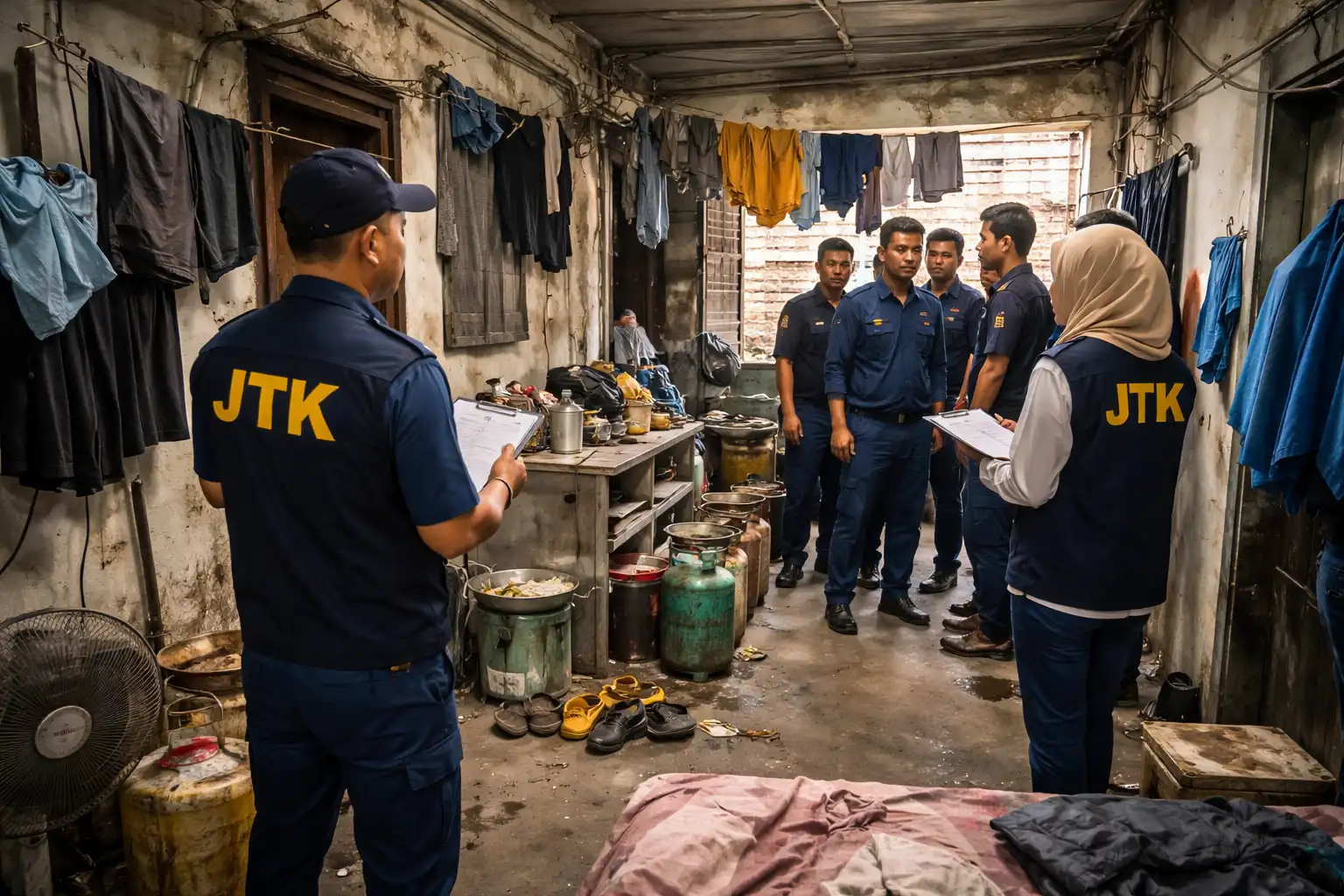
The fragmentation of worker housing poses a significant challenge. Monitoring workers becomes more challenging when they are dispersed across multiple residential units or buildings that have been customised to meet their specific needs. JTK still has to enforce the law, but it's harder to do because accommodation is spread out, inconsistent, and difficult to standardise. In contrast, CLQ is directly linked to the legal concept of centralised accommodation under Act 446. Employers or centralised accommodation providers can apply for Certificates of Accommodation. This classification is important because it makes a clear regulatory category instead of a bunch of different living situations.
This classification is why CLQ can be seen as helping JTK do its job better. The department still needs to do inspections, investigations, and enforcement action when necessary, but a centralised accommodation framework makes it easier to handle accommodations in many different places. This citation is not a direct quote from JTKSM, but it makes sense based on the certificate system, the list of public accommodation centres, and the fact that centralised accommodation providers are legally recognised. CLQ makes it easier for JTK to run their accommodations.
Why employers should understand this JTK-CLQ relationship
This is important for employers because they shouldn't think of CLQ as just a way to run a hostel or buy a house. It has a lot to do with how JTK sees compliance with Act 446. If JTK is in charge of enforcing accommodation standards, processing certificates, and checking for compliance, then picking the right CLQ model can help an employer meet those standards. The point is not that CLQ gets rid of all compliance duties. The reason is that CLQ is more in line with the rules Malaysia has set for worker housing.
Part IIIA of the Act says that employers must provide housing for foreign workers, which makes this even more important. This means that for many employers who hire foreign workers, providing housing is not an option. When accommodation becomes a legal requirement, the issue shifts from whether to provide it to how to do so in a manner that withstands JTK examination. CLQ is becoming more important because it gives a more organised answer to that question.
How Work Connect practical bridge between employers and JTK requirements.

Work Connect helps by taking messy, scattered worker housing and turning it into a structured system. JTK wants accommodations to be safe, clean, and comfortable under Act 446, and JTKSM’s official accommodation section points employers to acts, forms, checklists, FAQs, and a worker accommodation center list. Work Connect’s role is to make that process more manageable for employers by providing a centralised site, clearer operations, better records, and a single accountable manager instead of multiple uncontrolled units.
1. Give CLQ-compliant housing
Work Connect says its housing is designed for safety, comfort, and following the rules. It also says it provides secure, fully managed housing for foreign workers. That helps employers who need a more organised housing situation rather than short-term rentals.
2. Take care of daily tasks so that employers don't have to
The page for managing labour quarters says it takes care of maintenance, cleaning, security, helping residents, keeping track of occupancy, and reporting. This is useful because compliance with accommodations isn't just about the building; it's also about how well the site is run every day.
3. Make it easier to follow the rules with JTK
The framework for JTKSM includes Act 446, the 2020 rules for accommodations, the 2021 rules for employee accommodations, and checklists for applying for certificates. By keeping accommodations organised, documented, and easier to assess, Work Connect can help employers get ready for this situation. I would word this carefully to say that it helps with compliance readiness, not that it can take the place of JTK approval.
4. Make the audit trail better
Work Connect says it keeps records, fills out paperwork, registers residents, reports, tracks occupancy, and documents incidents. This is important because the more traceable and documented a worker housing operation is, the easier it is for an employer to show that they are in charge and responsible.
5. Give people in Perak a local solution
The contact page says that CLQ mainly works in Perak and has locations in Tasek, Gopeng, Simpang Pulai, Bidor, National Garden, Pengkalan, and Chemor. For employers in and around Ipoh and Perak, Work Connect has a strong local angle: it can get people to work faster, make it easier to get to sites, and find accommodations that are more specific to the area.
The best way to put it is like this:
WorkConnect helps employers meet workers' accommodation needs by offering centralised, professionally managed CLQ solutions that are easier to run, keep track of, and fit into JTK's Act 446 framework.
Conclusion
Work Connect helps turn worker accommodation from a complicated burden into a more structured and manageable solution. Work Connect helps employers improve worker living conditions and stay better prepared for JTK compliance requirements through professionally managed CLQ services, enhanced operational control, and support aligned with Malaysia’s accommodation standards.