
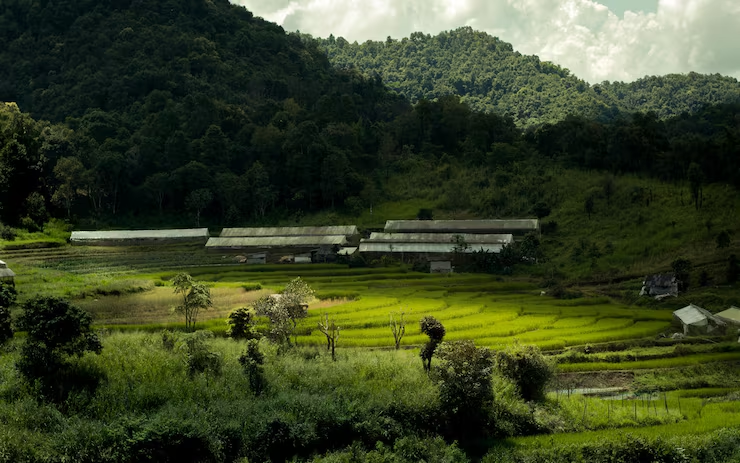
Cameron Highlands Foreign Worker Accommodation: From Compliance to Sustainable Workforce Management
Cameron Highlands is one of the most well-known highland areas in Malaysia. It is known for its agriculture and strong tourism economy. Hotels, restaurants, and tourism services work with vegetable, flower, and tea plantations to make up the main part of the local economy.
Both sectors rely on foreign workers to some extent. Over time, foreign workers have become very important to daily operations, helping with cleaning, maintenance, logistics, farm production, and hospitality services. As these industries get bigger, managing the workforce has become harder. Cameron Highlands Accommodation for foreign workers is now a major management issue, in addition to hiring and productivity.
Accommodation is no longer just a simple logistical arrangement. People are starting to see it more as a matter of following the rules, managing risks, and keeping operations stable over the long term. This article looks at the realities of accommodation in Cameron Highlands and why a structured, system-driven approach is becoming necessary.
1. Comprehending the Employment Environment in Cameron Highlands
The agricultural sector in Cameron Highlands needs workers all year round. Planting, harvesting, processing, and distribution all rely heavily on foreign workers because there aren't enough local workers.
The tourism and hospitality industry also adds to the demand, as it needs people to work in housekeeping, the kitchen, service roles, and maintenance. The number of workers needed changes during busy times.
This makes the area very crowded with workers. There is always a lack of space because there isn't much land, the terrain is hilly, and there are rules about development.
So, the challenge is not only to hire workers, but also to find a safe, responsible, and long-term way to house them. In this setting, accommodation is no longer a support service. It is a problem with strategic management.
2. The Change from "Providing Housing" to "Managing Accommodation"
In the past, many employers thought about housing for their workers in a practical way. As long as employees had a place to live, the job was done. People often made arrangements for housing by using available properties like shoplots, converted houses, or shared units, but they didn't plan for the long term.
However, as regulations strengthened and expectations evolved, this approach became increasingly insufficient. The enforcement of minimum accommodation standards has made it clear that housing is no longer an informal arrangement. It is a duty that is controlled.
Today, people expect accommodation to be:
Planned, not made up on the spot—made with safety, capacity, and long-term use in mind
Not random, but structured, with clear layouts, facilities, and management flow to back it up
Managed, not just given, with responsibility, upkeep, and ongoing supervision
This change is part of a bigger change in how the workforce is managed. Now, employers are expected to be responsible for both the conditions of work and living. This change has direct effects on the stability of operations and the continuity of business in Cameron Highlands, where space is limited and the workforce is dense.
3. The Truth About Problems Finding an Accommodation to Stay in Cameron Highlands
Cameron Highlands has a unique set of conditions that make it harder to manage accommodations than in most cities or industrial areas. There isn't always enough flat land, and the terrain is hilly, so building housing for workers isn't always possible. Because of this, many businesses use buildings that weren't meant for a lot of people to live in.
At the same time, most of the infrastructure in the area is built to support homes and tourists, not a lot of workers. When the number of places to stay goes up, it becomes clearer that water supply, sewage systems, waste management, and access roads are under more stress. For many employers, managing accommodations is not their main area of expertise, which adds another layer of responsibility to their operations.
These things usually cause:
Too many people because there isn't enough space
Facilities being pushed beyond their intended limits
Standards for cleanliness and maintenance are not always the same
Not enough structured oversight and responsibility
Management that reacts instead of planning control
These problems may not be obvious right away, but they tend to show up over time as the number of workers grows and more attention is paid to the rules.
4. Accommodating as a Business Risk, Not Just a Matter of Operations
One of the most important changes in how people think is realising that accommodation is no longer a side issue. It is now directly connected to the risk of doing business. If you don't meet the minimum standards, you could be investigated, fined, or have your business operations disrupted.
From a reputational point of view, the conditions of a company's accommodations can affect how stakeholders, partners, and the community at large see it. From a business point of view, bad living conditions can hurt employee morale, health, and productivity.
In real life, risks related to accommodations can show up as:
Health problems that make it hard for workers to be available
More people leaving
Less productive
More work for management
Costs for emergency repairs or fixes that you didn't expect
These risks don't always show up on financial statements, but they have a direct effect on how stable and successful a business is. In places with a lot of people, like Cameron Highlands, where operations are closely linked and margins can be affected by changes, the risk of not being able to find a place to stay becomes even more important.
5. Fragmented Housing and Operational Inefficiency
A lot of businesses in Cameron Highlands still use a broken accommodation model. Workers may live in more than one place, and these places may be in different buildings or neighbourhoods. Even though this method may seem easy to use at first, it creates big problems for management.
Fragmented housing results in:
Hard to keep standards consistent
More work for supervisors
More likely to not follow the rules
More complicated logistics
Less visibility and control
These problems get worse as the number of workers grows. When there are 50, 100, or more workers, what was easy to handle with 10 or 20 workers becomes too much to handle.
This is why more and more people are moving towards more centralised and structured housing models. Centralisation doesn't always mean one big building, but it does mean that planning, standards, and management are all done in the same way.
6. Cameron Highlands: Why a System-Based Approach Is Important
Cameron Highlands is not a normal industrial area. Because of where it is, the environment, and the people who live there, it needs a more structured way to manage accommodations.
The terrain in the area makes it hard to expand. Its reputation as a tourist destination raises expectations for cleanliness, order, and harmony in the community. Its focus on farming causes seasonal spikes in the number of workers.
Because of these things, accommodation can't be an afterthought. It needs to be part of business planning. Employers in Cameron Highlands are doing a good job of managing three systems that overlap:
Making something or providing a service
Managing the workforce
Living space and housing
If one of these systems is weak, it has an effect on the others. A system-based approach makes sure that accommodation management is in line with operational needs instead of just responding to them.
7. The Part WorkConnect Plays in the Cameron Highlands Ecosystem
WorkConnect is not a typical property manager or hostel operator. It is a platform for managing housing for foreign workers that helps employers move from ad-hoc, fragmented housing arrangements to structured, system-based accommodation management.
The main idea is simple:
Accommodation should be planned, run, and run as a whole, not just as a side job.
This difference is very important in Cameron Highlands.
8. Planning with Compliance in Mind
WorkConnect has always planned accommodations with regulatory standards in mind. Instead of fixing compliance issues after they happen, planning is done with safety, space allocation, and facility needs in mind from the start.
This lowers the chance of having to take corrective action in the future and builds a stronger base for long-term operation.
9. Management of Systematic Operations
WorkConnect puts in place operational structures that include:
Easy ways for people to register as residents
Set schedules for maintenance
Regular checks
Frameworks for hygiene and housekeeping
These things change accommodation from a passive asset to an environment that is actively managed.
10. Making it Easier for Employers to Manage Their Employees
One of the biggest problems for employers is that managing accommodations takes time and attention away from important business tasks.
WorkConnect's model is meant to take this burden away. Employers can focus on production, service quality, and business growth when they treat accommodation as a managed system.
11. Made for Places with a Lot of People
Cameron Highlands needs solutions that work in places with a lot of people and not a lot of space. WorkConnect's method focuses on order, efficiency, and sustainability to make sure that housing doesn't cause problems for the rest of the community.
12. Changing the Way People Think About Accommodations from Reactive to Proactive
Employers often use reactive management as a way to run their businesses. Problems are dealt with when they come up, when people complain, or when inspections are planned.
This method may seem cheap at first, but it makes things unstable in the long run. Management that reacts leads to:
Spending in case of an emergency
Interruption of operations
More stress for management teams
Results that can't be predicted
Instead of just reacting to problems, a proactive approach sees accommodation as part of long-term business planning. It means planning for workforce growth, building enough capacity ahead of time, setting up management systems early, and regularly reviewing standards.
This method is not only better for business, but it is also better for strategy. Proactive accommodation management helps growth that is stable and predictable, while reactive management often makes growth harder and causes problems that don't need to happen.
Conclusion: Structure is the key to stability.
Housing for foreign workers in Cameron Highlands is no longer a minor issue. It is now at the crossroads of compliance, managing the workforce, keeping operations stable, and making sure the business can last for a long time.
For employers who work in places with a lot of people, housing is no longer a side issue. It is a top priority for management.
Ad-hoc arrangements may seem to work for a while, but they get weaker as operations grow. Scale brings complexity, risk, and inefficiency when there is no structure. System-based management, on the other hand, makes things clearer, gives you more control, and makes you stronger.
This is where WorkConnect comes in.
WorkConnect helps employers move from making up housing arrangements on the fly to managing housing in a structured, system-driven way. WorkConnect helps businesses make their workplaces compliant, manageable, and sustainable by treating accommodation as an operational system instead of an afterthought.
In a place like Cameron Highlands where there is a lot of demand and not a lot of space, stability doesn't come from making things up as you go. It comes from having a plan, structure, and systems in place.